
AUBO-CB-iS Series Controller User Manual
1 About this Manual
1.1 Version information
| Item | Content |
|---|---|
| Manual name | AUBO-CB-iS Series Controller User Manual |
| Manual version | v1.0.2* |
| Release date | 2026-09-22 |
| Applicable products | AUBO-CB-iS, AUBO-CB-iS-H |
The User Manual will be regularly checked and revised, and the updates will be incorporated in the new version. The information in this manual is subject to change without notice.
Please read this manual before installing and using the product described herein, and keep this manual for the convenience of reading or reference when necessary.
All pictures in this manual are for reference only and the product received serves as the standard.
1.2 Copyright and Disclaimer
This Manual is the exclusive property of AUBO (Beijing) Intelligent Technology Co., Ltd. and may not be copied, reproduced in whole or in part, or converted into any other form for use without the written permission of AUBO (Beijing) Intelligent Technology Co., Ltd.
AUBO (Beijing) Intelligent Technology Co., Ltd. shall not be liable for any errors or omissions in this Manual, or for any accidental or consequential injuries arising from the use of this Manual and the products described therein.
Copyright © 2015-2026 AUBO All rights reserved.
1.3 Use of this Manual
This Manual is applicable to the installation, commissioning, pre-operation inspection, maintenance, repair, handling, storage and disposal of AUBO-CB-iS and AUBO-CB-iS-H.
This Manual does not replace the risk assessment, on-site safety design, operation instructions, or the applicable laws, regulations and safety standards of the system integrator in the country/region where the robot is used.
1.4 Intended Use of the Controller
The AUBO-CB-iS series controller can be used in general industrial equipment and general commercial equipment. It is only allowed to be used under the specified environmental conditions. For specific information about the operating environment and operating conditions, please refer to the technical specification table.
The AUBO-CB-iS series controller has special safety level features. The use of sharp end effectors or tool connectors may be dangerous.
Prohibited uses include but are not limited to the following:
- Used in flammable, explosive and other hazardous environments.
- Used in devices for moving or carrying persons or other animals.
- Used in medical equipment and other devices involving human life.
- Used in devices that have a significant impact on society and publicity.
- Used in vehicles, ships, etc. subject to vibration.
- Used as climbing tools.
1.5 Intended readers
This Manual is intended for the following professionals:
- Installation personnel
- Commissioning and operating personnel
- Maintenance and repair personnel
- Safety management personnel
1.6 Preconditions for operation
Readers who read and use this manual shall meet the following requirements:
- Have received relevant training from AUBO (or a dealer authorized by AUBO).
- Have the basic knowledge required for the installation and maintenance of mechanical, electrical and automation equipment.
- Be familiar with on-site safety management requirements, and have basic risk identification and safe operation awareness.
- Have read and understood the safety instructions in this Manual and associated documents.
1.7 Associated documents
When using this Manual, it is recommended to read the following document at the same time:
1.8 Additional information
For more information about products, services, training or technical support, please visit https://www.aubo-robotics.cn.
2 Safety
2.1 Safety Instructions
This chapter introduces the basic safety principles that shall be observed when operating the controller or the robot system. Integrators, users and operators must read this chapter carefully and strictly observe the instructions marked with safety warning signs.
Due to the complexity and potential danger of the robot system, this Manual cannot list all possible hazardous scenarios. Users and integrators shall carry out risk assessment in combination with the actual application, end tools, peripheral equipment, working environment and the range of personnel activities, and take appropriate risk reduction measures.
2.2 Warning Signs
The following warning signs are used in this Manual to indicate important safety information. When you see the relevant sign, be sure to read and observe the corresponding instructions.
| Sign | Level | Description |
|---|---|---|
 | DANGER | It indicates a possibly hazardous situation that, if not avoided, could result in death or serious injury. |
 | WARNING | It indicates a possibly hazardous situation, if not avoided, could result in injury to personnel or major damage to equipment. |
 | CAUTION | It indicates a possibly hazardous situation, if not avoided, could result in injury to personnel or damage to equipment. Attention shall be paid that the hazards indicated by this sign may sometimes cause more significant consequences, depending on the specific circumstances. |
 | NOTICE | It indicates a situation that, if not avoided, could result in injury to personnel or damage to equipment. Attention shall be paid that the hazards indicated by this sign may sometimes cause more significant consequences, depending on the specific circumstances. |
2.3 General Safety Regulations
The following basic safety guidelines must always be observed when operating the controller and its related equipment. This section lists general safety requirements, and the safety instructions in specific scenarios will be detailed in the relevant chapters of this Manual.
Always install the machine and all electrical equipment in accordance with the requirements and specifications herein.
Make sure to perform a preliminary test and inspection of the machine and its protection system before using the robot or putting it into production for the first time.
Before starting the robot or robot system for the first time, check whether the robot or robot system is in good condition and safe for operation, without any damage detected; and test, with all safety functions covered, whether the currently effective national or local safety production rules and regulations are satisfied.
Always check that all safety parameters and user programs are correct and that all safety functions are working properly, which must be done by personnel qualified to operate the robot. Do not start the robot until it has passed the thorough safety test, proving that it reaches the specified safety level.
Always get the installation and commissioning performed by professionals according to the installation standards.
When the robot is installed, carry out a comprehensive risk assessment again and keep a record therefor.
Always get the setting and modification of safety parameters carried out by authorized personnel, and apply security measures such as password or isolation measure to prevent their unauthorized modification or setting. After the safety factor is modified, be sure to analyze the relevant safety functions.
In case of an accident or abnormal operation, press down the emergency stop button to stop the robot if necessary.
The robot arm is equipped with collision detection. During powered operation of the robot, if the external force exceeds the normal force range set by the user's safety parameters, the robot will stop automatically to prevent equipment damage or operator injury from collision.
This function requires that the robot system operates within its normal operating range and uses an AUBO series controller. If the user develops the controller by themselves, the robot will not have the above function, and the user shall bear the resulting dangerous consequences.
Since connection of different machines may increase the risk or lead to new dangers, always perform a comprehensive risk assessment for the entire installation. When different safety and emergency shutdown performance levels are required, always select the highest one.
AUBO (Beijing) Intelligent Technology Co., Ltd. shall not be liable for any robot damage or personal injury caused by improper operation.
Prohibited actions:
| Sign | Description |
|---|---|
| 1. It is strictly forbidden to start the robot system before completing the safety inspection and risk assessment. Before the first startup, the system integrity check, all safety function tests, safety parameter correctness verification and risk assessment document review must be completed. 2. It is strictly forbidden to power on the controller without connecting the protective earth wire (PE wire). Poor grounding may cause electric shock, equipment damage or electromagnetic interference. 3. It is strictly forbidden to use the controller in a humid environment or an environment with conductive dust, which may cause personal injury or death. 4. It is strictly forbidden to frequently switch the power supply system on and off manually. The robot arm joint module is equipped with a brake, which keeps the robot posture when powered off. Do not frequently switch the power supply system on and off manually. It is recommended that the interval between each power-on/off be greater than 10 seconds. 5. It is strictly forbidden to touch heating parts while the equipment is running. Do not operate or touch the equipment when the robot is working or immediately after it stops. Cut off the power supply and wait for one hour until the equipment cools down. 6. It is strictly forbidden to modify safety parameters or bypass safety functions without authorization. |
Operating specifications:
| Sign | Description |
|---|---|
| 1. Ensure that the controller and related equipment are firmly installed. Improper installation may cause the equipment to fall off or operate abnormally. 2. Ensure that the robot system has sufficient working space, free of obstacles, sharp corners or pinch points. The operator's head and face should be outside the reach of the robot arm. 3. Do not connect safety devices to general-purpose I/O interfaces, and instead, please use safety-related interfaces only. 4. Correctly configure installation parameters, including installation angle, TCP weight and offset, safety parameters, etc. 5. If the controller or robot system is damaged, do not continue to use it. Stop it immediately and contact AUBO or an authorized service provider. 6. A safety assessment must be carried out after each installation to confirm that all safety functions are normal. |
| 1. Before transporting the controller, check the insulation and protection measures. During transportation, handle it carefully to avoid bumps. 2. Do not expose the controller to a permanent magnetic field for a long time, as strong magnetic fields can damage the equipment. 3. Do not modify the controller without authorization. Any unauthorized modification will void the warranty, and AUBO shall not be liable for any liability arising therefrom. |
2.4 Operator Safety
When operating the robot system, personnel safety shall be guaranteed first. Users and integrators shall take at least the following measures:
- Ensure that all relevant personnel have received training from AUBO (or a dealer authorized by AUBO) and fully understand the safe and standardized operating procedures. Training inquiries: support@aubo-robotics.cn.
- When operating, tie up hair, do not wear loose clothing or jewelry. When the robot is stationary, it may be in a standby state and should be regarded as continuously running. Do not approach it at will.
- In emergency situations such as when a person is caught or trapped, the joint can be forced to move by pushing or pulling the robot arm with force. Manual movement of the robot arm without electric drive is for emergency use only, and may cause damage to the robot arm joint.
- Personnel must not place their head, face, neck, fingers or other body parts in areas where they may be hit, pinched or drawn in.
2.5 Responsibilities and Regulations
The controller is a part of a complete robot system, and it does not constitute a complete machine by itself. Therefore, this Manual does not cover the complete set of design, installation and operation schemes for a complete robot, nor does it list all risk conditions that may affect the safety of the peripheral equipment of the complete integrated system. The installation safety performance of a complete robot depends on the design and construction of the complete integration scheme. The equipment integrator shall carry out risk assessment on the design and installation of the complete integrated system in accordance with the applicable local laws, regulations, safety codes and industry standards.
All safety information contained herein shall not be regarded as a guarantee from AUBO (Beijing) Intelligent Technology Co., Ltd. Even if all safety instructions referred to herein are strictly observed by operators, personal injury or equipment damage is still likely to occur.
AUBO (Beijing) Intelligent Technology Co., Ltd. is committed to continuously improving the performance and reliability of its products, and reserves the right to upgrade products without notice. AUBO (Beijing) Intelligent Technology Co., Ltd. has made every effort to ensure the accuracy and reliability of the information in this manual, but shall not be liable for any errors or omissions therein.
2.5.1 Responsibilities of the Integrator
The integrator shall assume the following key responsibilities:
- Conduct a comprehensive risk assessment of the complete robot system.
- Ensure that the design, installation and commissioning of the entire system meet the safety requirements.
- Provide necessary training to users and related operators.
- Develop complete system operation specifications and emergency plans.
- Establish and maintain appropriate safety protection measures.
- Adopt appropriate methods to eliminate hazards or minimize any hazards to an acceptable level at the time of final installation.
- Communicate the residual risks to the end users.
- Mark the integrator's information on the robot.
- Archive all relevant technical documents and risk assessment reports.
2.5.2 Reference Standards
The integrator may refer to the following international standards to carry out the risk assessment process:
| Standard No. | Name | Description |
|---|---|---|
| ISO 12100:2010 | Safety of Machinery - General Principles for Design - Risk Assessment and Risk Reduction | Basic framework for risk assessment |
| ISO 10218-2:2025 | Robots and Robotic Devices - Safety Requirements for Industrial Robots - Part 2: Robot Systems and Integration | Safety requirements for industrial robot integration |
| RIA TR R15.306-2014 | Technical Report - Industrial Robots and Robot Systems - Safety Requirements - Task-based Risk Assessment Methodology | Task-based risk assessment guide |
| ANSI B11.0-2010 | Safety of Machinery; General Requirements and Risk Assessment | US machinery safety standard |
For applicable standards and regulations, please visit the AUBO official website www.aubo-robotics.cn or consult the local regulatory authority.
2.6 Hazard Identification
The risk assessment shall consider potential hazards during normal use, commissioning, maintenance, cleaning, abnormal recovery and foreseeable misuse. When no peripheral safety protection devices are used, the use of a collaborative robot arm may involve the following potential hazards:
- Risk of puncture or cutting caused by the use of sharp end effectors or tool connectors.
- Exposure risk when handling toxic, corrosive or other harmful substances.
- Risk of the operator's fingers or limbs being pinched by the robot arm joints or base.
- Risk of collision with personnel during the motion of the robot arm.
- Risk of falling objects caused by improper fixing of the end tool.
- Hazards caused by the impact between the robot payload and a solid surface. The integrator must measure such hazards and the related risk levels through risk assessment, and determine and implement corresponding measures to reduce the risk to an acceptable level. Please note that a specific robot may still have other significant hazards.
Combined with the inherent safety design of the AUBO robot and the safety specifications and risk assessment formulated by the integrator and the end user, the risks related to robot arm collaborative operation can be reduced to a reasonably feasible range. This document is intended to communicate the residual risks existing before the robot installation to the integrator and the end user. If the integrator determines, after the risk assessment, that the corresponding application scenario has hidden dangers that will cause unacceptable risks to operators, the integrator must take appropriate risk reduction measures to eliminate or minimize these hazards until the risk level reaches the acceptable standard. Use of the robot is prohibited before the necessary risk reduction measures are completed.
If the robot adopts a non-collaborative deployment scheme (such as carrying dangerous working tools), the risk assessment result may require the integrator to additionally equip safety devices (such as safety start-up devices) during the program development stage to ensure the safety of personnel and equipment.
2.7 Emergency Response
2.7.1 Emergency Stop Device
Pressing the emergency stop button will immediately stop all motions of the robot. The emergency stop device is not intended as a risk reduction measure, but can be used as a secondary protection device. If multiple emergency stop buttons are to be connected, they must be included in the risk assessment of the robot application. The emergency stop button meets the requirements of IEC 60947-5-5.
The controller is also equipped with an external emergency stop button interface, which can be used by the integrator or user according to the actual situation.
| Sign | Description |
|---|---|
| 1. Pressing the emergency stop button triggers a Category 1 stop. For descriptions of stop categories, see Appendix. 2. Tooling or equipment connected to the end of the robot arm must be integrated into the emergency stop circuit of the system if they pose a potential threat. Failure to comply with this warning may result in death, serious personal injury or major property damage. |
2.7.2 Recovery from Emergency Stop State
All emergency stop devices designed in the form of a button feature a "lock", which must be unlocked to end the emergency stop state.
The "lock" can be unlocked by rotating the emergency stop button.
| Sign | Description |
|---|---|
| Recovering from the emergency stop state is a simple but very important step, which can be operated only when the danger of the robot system is confirmed to be completely eliminated. |
3 Handling and Precautions
When packaging for transportation, carry out the packaging according to the packaging standard, and make the required marks on the outside of the packaging box.
During transportation, ensure that the equipment is stable and fixed in a proper position.
The controller shall be lifted with a handle. When handling, the moving parts shall be positioned by appropriate measures to prevent accidental movement during handling and transportation, which may cause hazards.
When moving the AUBO-CB-iS controller from the packaging materials to the installation position, hold the equipment steadily and avoid collision.
After fixing the equipment, power it on and observe whether it works normally.
After the transportation is completed, keep the original packaging. Store the packaging materials in a dry place for future repacking and moving of the equipment.
| Sign | Description |
|---|---|
| 1. Make sure that your back or other body parts are not overburdened when lifting the equipment. 2. Comply with all regional and national guidelines. AUBO (Beijing) Intelligent Technology Co., Ltd. shall not be liable for any damage caused during the transportation of the equipment. 3. Make sure to strictly follow the installation instructions in this manual when installing the equipment. |
4 Maintenance and Disposal
4.1 Maintenance and Repair
When carrying out various maintenance and repair operations, strictly comply with all safety specifications in this manual.
The maintenance, calibration and repair of the equipment shall be carried out in accordance with the latest version of the Service Manual, which can be obtained on the official technical support website www.aubo-robotics.cn. All authorized dealers of AUBO (Beijing) Intelligent Technology Co., Ltd. can log in and access this website.
The repair of the equipment can only be carried out by authorized system integrators or AUBO factory personnel. If parts need to be returned to AUBO (Beijing) Intelligent Technology Co., Ltd., the relevant procedures in the Service Manual must be strictly followed.
During the operation, the safety level requirements corresponding to maintenance and repair must be met, and the current local safety production regulations must be observed. After the operation is completed, all safety functions must be tested one by one to confirm that they work normally.
Maintenance and repair work is used to ensure the stable operation of the equipment, or to restore the normal working condition after a fault occurs, covering two types of work content: fault diagnosis and physical repair.
When operating the controller or robot system, strictly implement the following safety procedures and warnings:
| Sign | Description |
|---|---|
| 1. Remove the main input cable from the rear of the controller to ensure that it is completely powered off. Take necessary precautions to prevent others from re-energizing the system during maintenance. After power-off, check the system again to ensure that it is powered off. 2. Check the grounding connection before restarting the system. 3. Comply with ESD (electrostatic discharge) regulations when disassembling the robot arm or controller. 4. Avoid disassembling the power supply system of the controller. The power supply system may retain high voltage for several hours after the controller is turned off. 5. Avoid water or dust entering the robot arm or controller. |
| 1. Replace faulty parts with new parts of the same part number or corresponding parts approved by AUBO (Beijing) Intelligent Technology Co., Ltd. 2. Reactivate all disabled safety measures immediately after the work is completed. 3. Record all maintenance operations in writing and keep them in the technical documents related to the entire robot system. 4. The controller has no parts that can be repaired by the end user. If maintenance or repair service is needed, contact your dealer or AUBO (Beijing) Intelligent Technology Co., Ltd. |
4.2 Disposal
The AUBO-CB-iS controller must be disposed of in accordance with the applicable national laws, regulations and national standards.
5 Warranty
5.1 Product Warranty
AUBO robots have a limited warranty period of 36 months.
If the new equipment and its components have defects caused by manufacturing or material defects within 36 months after being put into use, AUBO (Beijing) Intelligent Technology Co., Ltd. shall provide necessary spare parts to replace or repair the relevant parts.
The ownership of the equipment or components replaced or returned to AUBO (Beijing) Intelligent Technology Co., Ltd. belongs to AUBO (Beijing) Intelligent Technology Co., Ltd.
If the product is no longer within the warranty period, AUBO (Beijing) Intelligent Technology Co., Ltd. reserves the right to charge customers for replacement or repair.
Outside the warranty period, if the equipment shows defects, AUBO (Beijing) Intelligent Technology Co., Ltd. shall not be liable for any damage or loss caused thereby, such as production loss or damage to other production equipment.
5.2 Disclaimer
If the equipment defect is caused by improper handling or failure to follow the relevant information described in the user manual, the "Product Warranty" shall be void.
Failures caused by the following circumstances are not covered by this warranty:
- Products purchased through channels not recognized by AUBO.
- Installation, wiring or connection to other control equipment that does not conform to industrial standards or is not carried out as required by the user manual.
- Use beyond the specification conditions or standards stated for the product.
- Use of this product for purposes other than those specified.
- Use environment conditions exceeding the product's ratings.
- Use in a grinding environment or a special use environment without product protection.
- Product damage caused by improper transportation.
- Failures, damage or indirect damage caused by accidents or human factors.
- Failures, damage or indirect damage caused by modification.
- Installation of non-genuine parts or accessories.
- Damage caused by modification, commissioning or repair of original parts by a third party other than AUBO (Beijing) Intelligent Technology Co., Ltd. or its designated integrators.
- Failures, damage or indirect damage caused by natural disasters or other force majeure.
- Failures caused by reasons other than the above that are not the responsibility of AUBO (Beijing) Intelligent Technology Co., Ltd.
The following circumstances are not covered by the warranty:
- The product traceability number cannot be identified.
- The production date or warranty start date cannot be identified.
- Changes to software or internal data.
- The fault cannot be reproduced or cannot be identified by AUBO (Beijing) Intelligent Technology Co., Ltd.
- Use of this product in radioactive equipment, biological test equipment, or uses judged by AUBO (Beijing) Intelligent Technology Co., Ltd. as dangerous.
- Appearance parts and wearing parts. According to the product quality assurance agreement, AUBO (Beijing) Intelligent Technology Co., Ltd. only provides quality warranty for defects in the products and parts sold to dealers.
AUBO (Beijing) Intelligent Technology Co., Ltd. does not assume any other express or implied warranties or liabilities, including but not limited to any implied warranties of merchantability or fitness for a particular purpose. In addition, AUBO (Beijing) Intelligent Technology Co., Ltd. does not assume any liability for any indirect damage or consequences arising from related products.
6 Controller Description
6.1 About the AUBO-CB-iS Series
AUBO-CB-iS series controllers include two models: AUBO-CB-iS and AUBO-CB-iS-H. 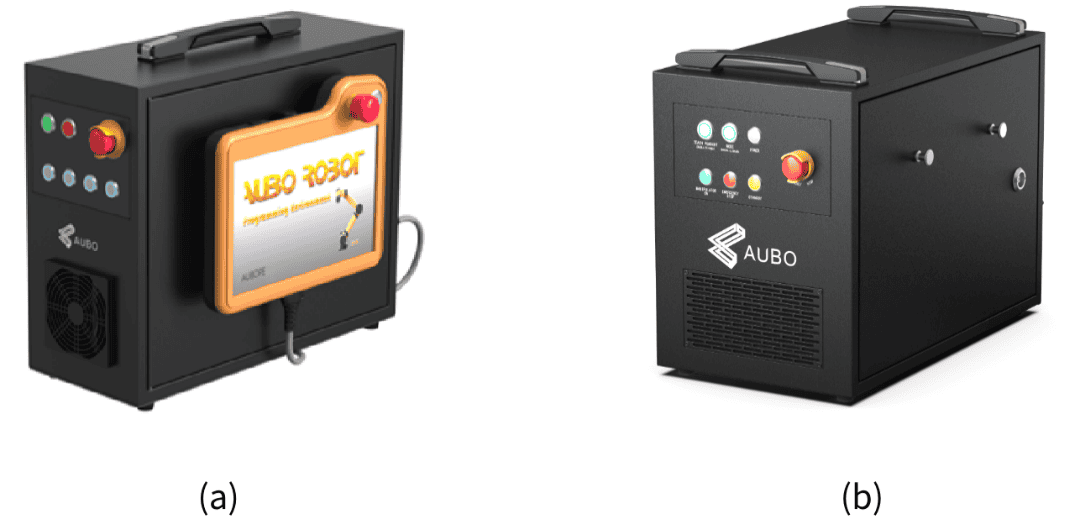
| Sign | Description |
|---|---|
| The AUBO-CB-iS controller is compatible with AUBO-iH, AUBO-iS and AUBO-C series robot arms. The AUBO-CB-iS-H controller is compatible only with the AUBO-iS35 robot arm. |
The controller is the control center of the AUBO robot. It contains a control mainboard, safety interface board, switching power supply and safety protection components. The controller is powered by 100 V–240 V AC. The internal switching power supply converts 100 V–240 V AC into 12 V, 24 V and 48 V DC to supply power to the controller loads and the robot. Before use, check that the cables between the robot, teach pendant and controller are securely connected.
The controller has both hardware and software protection to maximize safety during use. Multiple circuit breakers are used inside the controller to provide reliable short-circuit and overload protection. An emergency stop button is provided on the front panel, enabling users to cut off robot power as quickly as possible to protect personnel and equipment.
6.2 Technical Specifications
6.2.1 AUBO-CB-iS
| Controller type | AUBO-CB-iS | |
|---|---|---|
| Dimensions (L*H*W) | 400 mm * 320 mm * 160 mm | |
| Weight | 12.5 kg (27.5 lbs) | |
| Operating temperature | 0°C ~ 50°C | |
| Operating humidity | 90% relative humidity (non-condensing) | |
| Transport and storage temperature | -25°C ~ 55°C | |
| IP rating | IP43 | |
| Power supply | 100 V ~ 240 V AC, 50 Hz ~ 60 Hz | |
| I/O power supply | 24 V 3 A | |
| I/O ports | Digital input | 16 (general) + 16 (configurable) |
| Digital output | 16 (general) + 16 (configurable) | |
| Analog input | 2 | |
| Analog output | 2 | |
| Incremental encoder | 1 | |
| RS485 | 1 | |
| Wireless module | Optional | |
| Communication protocols | Ethernet, Modbus-RTU/TCP, Profinet, Ethernet/IP (optional) | |
| Interfaces and openness | SDK (C/C++/C#/Lua/Python/JavaScript for Windows + Linux), ROS/ROS2 system support, API | |
| Cables | Robot arm cable | 5 m (customizable, up to 8 m) |
| Teach pendant cable | 4 m | |
| Power cable | 5 m | |
6.2.2 AUBO-CB-iS-H
| Controller type | AUBO-CB-iS-H | |
|---|---|---|
| Dimensions (L*H*W) | 400 mm * 320 mm * 240 mm | |
| Weight | 18 kg (39.7 lbs) | |
| Operating temperature | 0°C ~ 50°C | |
| Operating humidity | 90% relative humidity (non-condensing) | |
| Transport and storage temperature | -25°C ~ 55°C | |
| IP rating | IP43 | |
| Power supply | 100 V ~ 240 V AC, 50 Hz ~ 60 Hz | |
| I/O power supply | 24 V 3 A | |
| I/O ports | Digital input | 16 (general) + 16 (configurable) |
| Digital output | 16 (general) + 16 (configurable) | |
| Analog input | 2 | |
| Analog output | 2 | |
| Incremental encoder | 1 | |
| RS485 | 1 | |
| Wireless module | Optional | |
| Communication protocols | Ethernet, Modbus-RTU/TCP, Profinet, Ethernet/IP (optional) | |
| Interfaces and openness | SDK (C/C++/C#/Lua/Python/JavaScript for Windows + Linux), ROS/ROS2 system support, API | |
| Cables | Robot arm cable | 5 m (customizable, up to 8 m) |
| Teach pendant cable | 4 m | |
| Power cable | 5 m | |
6.3 Panel Description
6.3.1 Front Panel
The structure and functions of the controller front panel are shown in Figure 6-2 and Table 6-1. 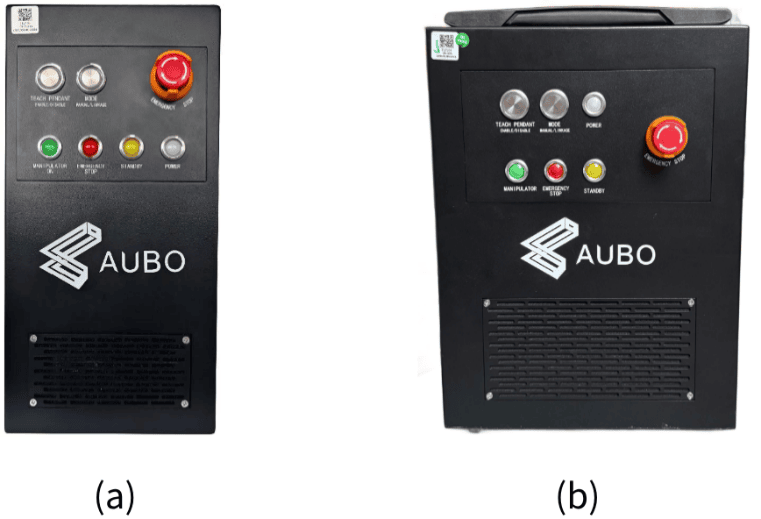
| No. | Name | Function |
|---|---|---|
| 1 | MANIPULATOR ON indicator | Lights up when the robot body power is connected normally. |
| 2 | EMERGENCY STOP indicator | Lights up when the robot is in the emergency stop state. |
| 3 | STANDBY indicator | Lights up when initialization of the controller interface board program is complete. |
| 4 | POWER indicator | Lights up when the external power supply is connected normally. |
| 5 | TEACH PENDANT ENABLE/DISABLE button | Wired teach pendant enable switch. By default, when the button is released, the wired teach pendant is available and the teach pendant emergency stop button is enabled. After the button is pressed, the teach pendant emergency stop button is disabled, allowing the wired teach pendant cable to be safely removed and the robot body to be controlled through interface signals. |
| 6 | MODE MANUAL/LINKAGE button | Switches the robot operating mode. The robot runs in manual mode by default. Press this button to enter linkage mode. |
| 7 | EMERGENCY STOP button | Emergency stop button. Press it to immediately stop robot operation. Rotate it in the direction indicated on the button label to restore normal operation. |
| Sign | Description |
|---|---|
| Pressing the emergency stop button triggers a Category 1 stop. For descriptions of stop categories, see Appendix. |
6.3.2 Rear Panel
The structure and functions of the controller rear panel are shown below. 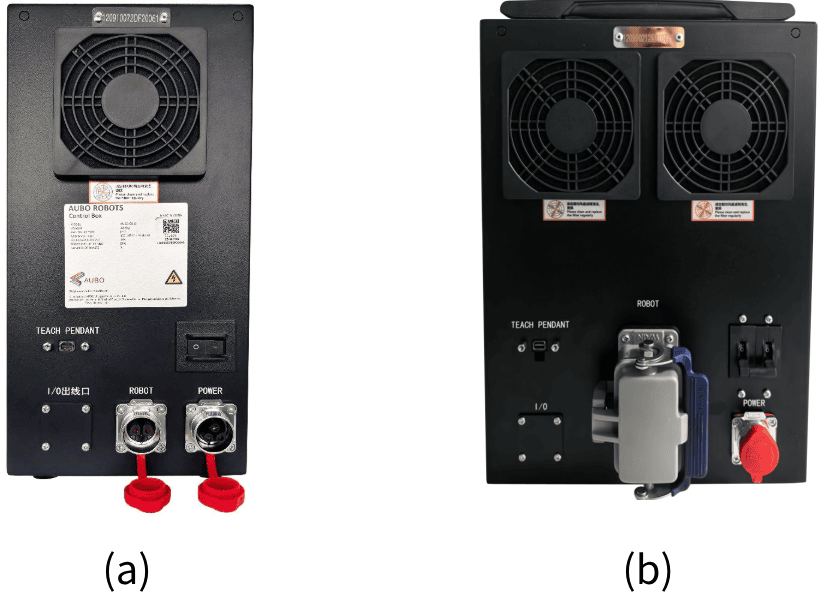
| No. | Name | Function |
|---|---|---|
| 1 | Power switch | Controller power switch. “I” indicates power on, and “O” indicates power off. |
| 2 | POWER port | Power cable port, used to connect the power supply. |
| 3 | ROBOT port | Robot arm cable port, used to connect the robot arm cable. |
| 4 | TEACH PENDANT port | Teach pendant cable port, used to connect the teach pendant cable. |
| 5 | I/O outlet | Outlet for internal controller I/O signals. |
6.3.3 Side Panel
Open the controller side panel to view and use the user electrical interfaces. For detailed interface layout and functions, see Figure 6-4 and Table 6-3. 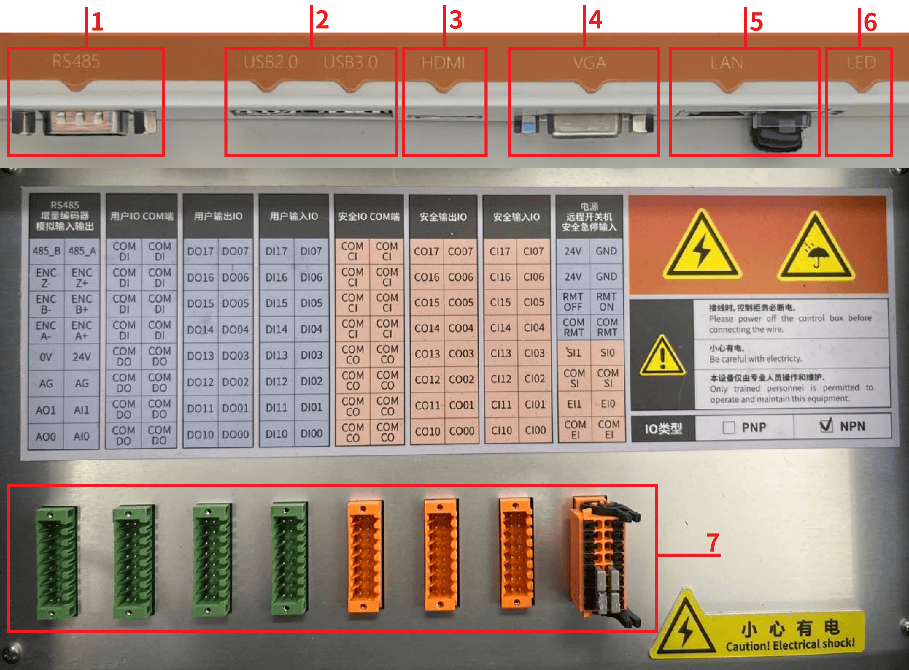
| No. | Name | Function |
|---|---|---|
| 1 | RS485 port | Supports Modbus-RTU communication, and can extend the number and types of controller I/O interfaces or add analog interfaces. |
| 2 | USB2.0 and USB3.0 ports | Used for device connection, software upgrade and project file export. |
| 3 | HDMI port | Connects to a monitor HDMI port. |
| 4 | VGA port | Connects to a monitor VGA port. |
| 5 | LAN outlet | Used for remote access and control. |
| 6 | LED indicator | Displays the operating status of the controller IPC. |
| 7 | Terminal interface | Provides signal connection to external devices and system expansion. |
7 Teach Pendant
7.1 Introduction
The AUBO-CB-iS series controller is equipped with AUBO's latest independently developed ARCS robot operating system and fully supports both wired and wireless teaching methods. Users can operate the robot arm and controller, execute and create robot programs, and read robot log information through the dedicated AuboStudio software to meet the needs of different application scenarios. For details, see the AuboStudio User Manual.
7.2 Wired Teach Pendant
The wired teach pendant is directly connected to the controller through a cable. Users can use AuboStudio software on the dedicated device for robot control and program development. 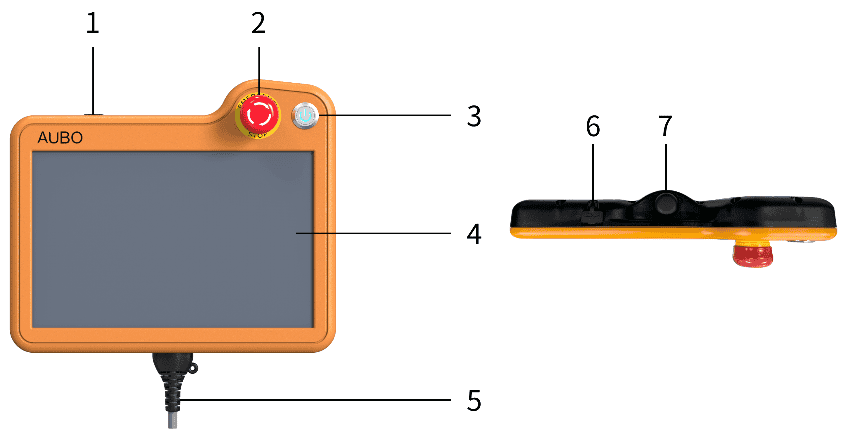
| Controller type | AUBO-TP-iS |
|---|---|
| Dimensions (LHW) | 254 mm * 213.1 mm * 40.8 mm |
| Weight | 1.0 kg (2.2 lbs) (including cable) |
| IP rating | IP54 |
| No. | Name | Function |
|---|---|---|
| 1, 6 | USB ports | Used for device connection, software upgrade and project file export. |
| 2 | Emergency stop button | Quickly stops robot operation in an emergency. After pressing it, rotate it in the specified direction shown on the button to restore normal mode. |
| 3 | System power switch | Controls startup and shutdown of the robot system, and can force shutdown when necessary. |
| 4 | Touch screen | Displays the robot operation interface and real-time status information. |
| 5 | Teach pendant cable port | Dedicated port for connecting to the controller, ensuring communication between the teach pendant and the control system. |
| 7 | Force control switch | Three-position enabling switch for safe robot teaching operation: OFF (released) => ON => OFF (pressed). When the switch is in the ON state, the robot can be operated safely. |
| Sign | Description |
|---|---|
| Pressing the emergency stop button triggers a Category 1 stop. For descriptions of stop categories, see Appendix. |
7.3 Wireless Teaching
If the AUBO-CB-iS series controller is equipped with built-in wireless Wi-Fi, users can install the Android version of AuboStudio on a tablet and connect to the robot through Wi-Fi for control.
8 Installation and Startup
8.1 Robot System Components
The AUBO robot system consists of five parts: robot arm, controller, base, teach pendant and optional accessories. It adopts a modular design to meet diverse automation application requirements.
Main system components and functions:
- Robot arm: The execution unit of the system. It consists of multiple joints and links, mimics the kinematic characteristics of the human arm, and realizes precise spatial pose control.
- Controller: The core control unit of the system, with AUBO's independently developed robot operating system built in. It establishes a dedicated communication link with the robot arm based on the real-time CAN bus to coordinate motion control, command execution and system status management.
- Base: Provides the installation foundation for the robot system to ensure stability and precise positioning. The base can be selected according to the application scenario.
- Teach pendant: The key interface for interaction between the user and the robot system. It supports both wired teaching through a dedicated cable and wireless teaching based on Wi-Fi, providing an intuitive programming, debugging and system configuration environment.
- Optional accessories: For specific application scenarios, extension modules such as control handles and six-axis force sensors can be added to enhance system adaptability and intelligence.
The AUBO robot system is highly modular and can be flexibly configured according to user requirements. Figure 8-1 shows a typical system configuration. The actual delivered system may vary depending on the specific application. The final configuration shall be subject to the physical product and technical specifications. For specific configuration details, contact the AUBO technical support team. 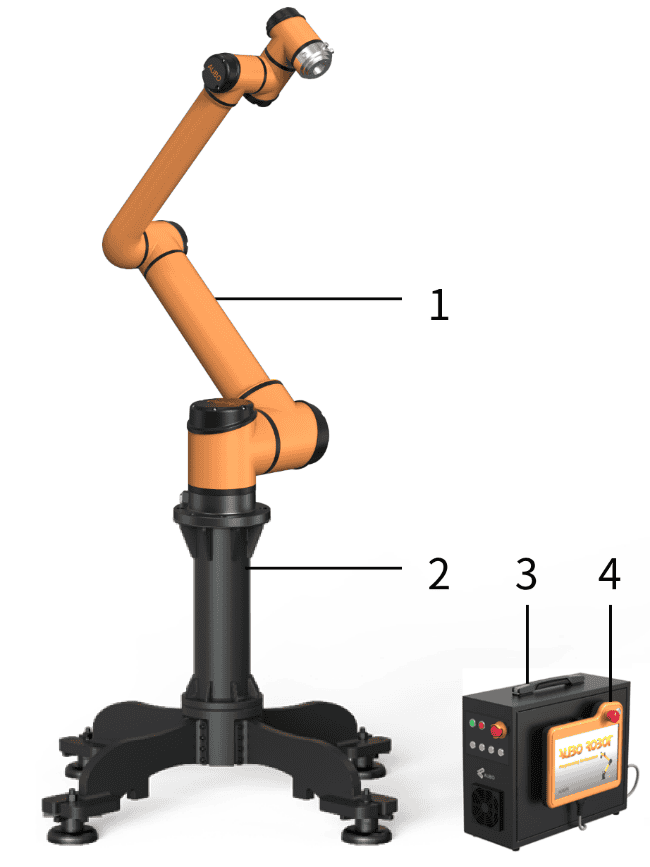
8.2 Important Safety Instructions
| Sign | Description |
|---|---|
| 1. Ensure that the controller, teach pendant and cables do not come into contact with liquids. A wet controller may cause death or injury. 2. Do not place the controller or teach pendant in dusty environments or places where the humidity exceeds the equipment IP rating. If conductive dust is present on site, pay special attention to protection. 3. Dangerous voltage is present inside the cabinet. Non-professionals must not open the cabinet while it is energized. 4. Do not directly touch screws or other metal components inside the controller by hand, and never remove wiring while energized. |
| 1. A safety assessment must be carried out after each robot installation, and the instructions in the Safety chapter must be strictly followed. 2. The controller shall be placed horizontally on the ground. A clearance of 50 mm shall be kept on each side of the controller to ensure ventilation and heat dissipation. 3. The teach pendant can be hung on the controller. Ensure that cables do not trip personnel. 4. If non-AUBO original accessories (such as cables) are installed on the robot, the user must ensure that such accessories do not interfere with or impair the safety functions of the equipment. 5. The software in the robot system supports only upgrade and use of the default software. Installation of other software systems such as ROS is prohibited. Check before use: 1. Check whether the controller power cable is properly connected. 2. Check whether the controller and robot are properly connected. 3. Check whether the controller support is stable and the complete machine is placed horizontally without shaking or offset. |
8.3 Cable Connection
The rear panel of the AUBO-CB-iS series controller has three ports, and the bottom of the robot arm has one port. Before use, connect the corresponding cables to the ports.
| No. | Name | Illustration |
|---|---|---|
| 1 | Robot arm aviation plug cable | 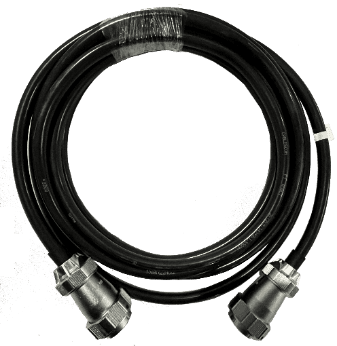 |
| 2 | Power cable | 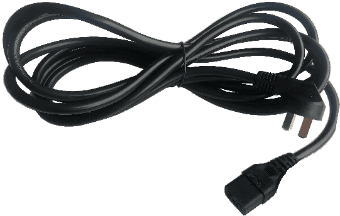 |
| 3 | Cable connection to controller rear panel port | 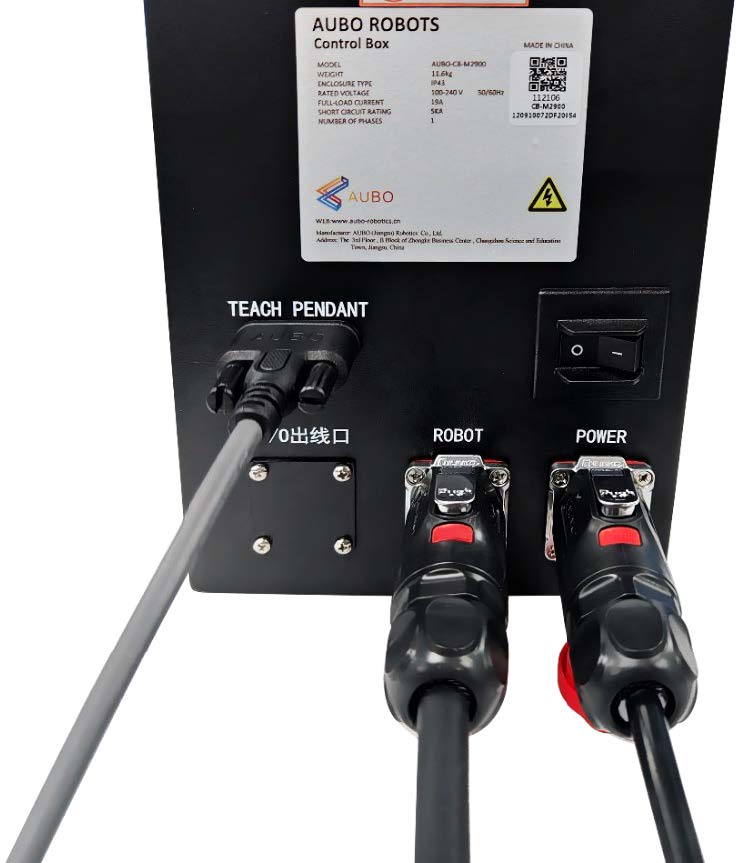 |
| 4 | Robot arm aviation plug cable connection to robot arm | 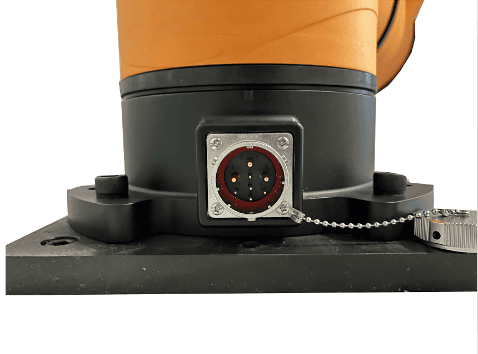 |
| No. | Name | Description |
|---|---|---|
| 1 | Robot arm aviation plug cable connection to robot arm | First remove the dust cap from the port at the bottom of the robot arm. Align the pins and holes of the plug and socket respectively. The notch on the socket must align with the protrusion on the plug. Insert the plug into the socket. Rotate the fastening nut on the plug clockwise, along the direction from the plug to the socket, until a “click” is heard, indicating successful connection. |
| 2 | Robot arm aviation plug cable connection to controller | First remove the red dust cap from the controller port, and then connect the power cable to the controller ROBOT port. Pay attention to the insertion direction. It will lock automatically after being fully inserted. |
| 3 | Wired teach pendant connection to controller | Insert the wired teach pendant cable plug into the TEACH PENDANT port of the controller and tighten the screws on both sides. |
| 4 | Power cable connection to controller | First remove the red dust cap from the controller port, and then connect the power cable to the controller POWER port. Pay attention to the insertion direction. It will lock automatically after being fully inserted. |
| Sign | Description |
|---|---|
| 1. Ensure that the robot is grounded correctly (electrical grounding). The grounding connector shall have at least the rated current of the highest current in the system. 2. Ensure that all cables are correctly connected before the controller is powered on, and use the original power cable correctly. |
| 1. Never disconnect robot power while the robot arm is powered on. 2. Never extend or modify original cables. |
8.4 Robot System Power-on
8.4.1 Preparation before Power-on
- Check whether the robot arm and controller are properly connected.
- Check whether the wired teach pendant and controller are properly connected.
- Check whether the controller power cable is properly connected.
- The controller power switch is off before power is connected.
- The wired teach pendant emergency stop switch is released.
- The MODE MANUAL/LINKAGE button is in the correct position.
- Ensure that the robot arm will not contact surrounding personnel or equipment.
8.4.2 System Power-on
- Controller power-on: Press the controller power switch from OFF to ON. The POWER indicator lights up, and the robot system is powered on.
- Wired teach pendant and robot arm power-on: Keep the MODE MANUAL/LINKAGE button released. The robot system is in manual mode. Wait until the STANDBY indicator lights up, indicating that the system enters standby. Press the system power switch at the upper right corner of the wired teach pendant for about 1 second. Wait until the LED indicator of the system power switch lights up. The robot and wired teach pendant power on together, and the teach pendant screen lights up.
| Sign | Description |
|---|---|
| During robot arm brake release after power-on, do not externally interfere with the robot, such as installing/removing tools or grippers, or shaking the robot. |
8.5 Robot System Shutdown
8.5.1 Normal Shutdown
The AUBO robot system can be shut down normally in the following ways:
- Method 1: Click the Shutdown button on the teaching software interface.
- Method 2: Remote shutdown.
- Method 3: Press and hold the system power switch button at the upper right corner of the wired teach pendant for 3 seconds.
- Method 4: Press and hold the power button on the control handle for 2 seconds.
After normal system shutdown, press the controller power switch from ON to OFF, and finally unplug the power cable from the external power supply.
8.5.2 Forced Shutdown
The AUBO robot system can be forcibly shut down in the following ways:
- Method 1: In any state, press and hold the system power switch button at the upper right corner of the wired teach pendant for 10 seconds.
- Method 2: In any state, press and hold the power button on the control handle for 10 seconds.
- Method 3: Cut off the power supply directly.
| Sign | Description |
|---|---|
| 1. Forced shutdown is allowed only in abnormal states. 2. Avoid forced shutdown. If forced shutdown is performed, save ongoing tasks and files as much as possible before shutdown, and perform necessary system inspection and maintenance afterwards. |
9 Electrical Interfaces
9.1 Introduction
The AUBO-CB-iS series controller provides diverse electrical interfaces to meet the needs of different automation application scenarios. The controller integrates video output, communication and digital/analog signal interfaces, and supports extensive system integration and device interconnection.
For the detailed interface layout, see “6.3.3 Side Panel”. For a summary of terminal interfaces, see Table 9-1.
| Interface type | Category | Interface name | Terminal No. | Quantity (channels) | Specification |
|---|---|---|---|---|---|
| Digital I/O | Fixed-function I/O | External safety stop input | SI0, SI1 | 2 | 24 VDC |
| Linked emergency stop input | EI0, EI1 | 2 | 24 VDC | ||
| Remote power-on | RMT ON | 1 | 24 VDC | ||
| Remote power-off | RMT OFF | 1 | 24 VDC | ||
| Configurable I/O (safety) | Digital input | CI00~CI07, CI10~CI17 | 16 | 24 VDC | |
| Digital output | CO00~CO07, CO10~CO17 | 16 | 24 VDC | ||
| General I/O (user) | Digital input | DI00~DI07, DI10~DI17 | 16 | 24 VDC | |
| Digital output | DO00~DO07, DO10~DO17 | 16 | 24 VDC | ||
| Analog I/O | General I/O (user) | Analog voltage input | AI0, AI1 | 2 | 0~+10 V |
| Analog voltage output | AO0, AO1 | 2 | 0~+10 V, 0~20 mA | ||
| Communication interface | - | RS485 | 485_A, 485_B | 2 | - |
| Encoder interface | - | Incremental encoder | ENC A+, ENC A-, ENC B+, ENC B-, ENC Z+, ENC Z-, | 6 | Differential signal |
9.2 Electrical Warnings and Cautions
When designing and installing robot and AUBO-CB-iS series controller applications, always follow the following warnings and cautions. These warnings and cautions also apply to maintenance operations.
| Sign | Description |
|---|---|
| 1. Ensure that all equipment that must not get wet is kept dry. If water enters the product, cut off the power supply and contact your supplier. 2. Use only the original cables of the robot. Do not use the robot in applications where those cables need to be bent. If longer cables or flexible cables are required, contact your supplier. 3. All GND terminals mentioned herein are used only for power supply and signal transmission. For protective earth (PE), use the screw terminal marked with the grounding symbol in the controller. The grounding connector shall have at least the rated current of the highest current in the system. 4. Always be careful when installing interface cables to the robot I/O. |
| 1. Never connect safety signals to a non-safety PLC with an inappropriate safety level. Failure to observe this warning may cause serious injury or death due to failure of a safety stop function. 2. The controller must be powered off when wiring the electrical interfaces of the controller. |
| 1. Interference signals higher than the levels specified in IEC standards may cause abnormal robot behavior. High signal electrodes or excessive exposure may permanently damage the robot. EMC problems usually occur during welding and are usually indicated by error messages in logs. AUBO (Beijing) Intelligent Technology Co., Ltd. shall not be liable for any losses caused by EMC problems. 2. I/O cables used to connect the controller with other machinery and equipment must not exceed 30 meters unless extension testing shows that this is feasible. |
9.3 Communication Interfaces
9.3.1 RS485 Interface
The AUBO-CB-iS series controller provides a standard RS485 interface, which can be used to connect Modbus devices. The pin description is shown below. 
9.3.2 USB Interface
The AUBO-CB-iS series controller provides USB2.0 and USB3.0 standard interfaces for device connection, software upgrade and project file export.
9.3.3 LAN Interface
The AUBO-CB-iS series controller is equipped with an industrial wired Ethernet interface as standard, providing efficient and stable network communication capability for the robot system and supporting remote access and control.
9.4 I/O Control Mode
9.4.1 Signal Level Control
The AUBO-CB-iS series controller supports both NPN and PNP level control modes, which are preset and marked before delivery, as shown in Figure 9-2. 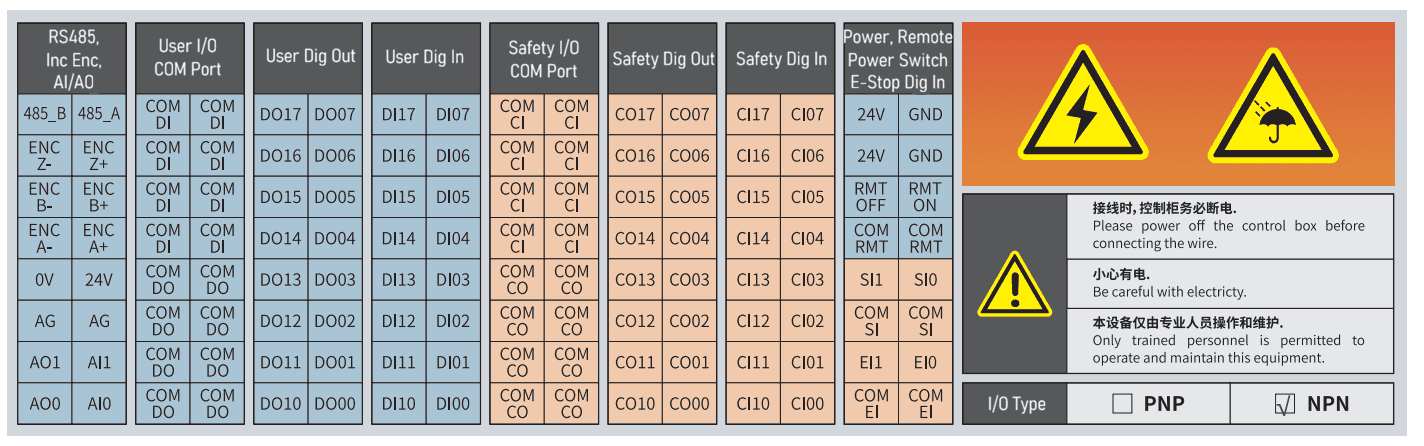
| Sign | Description |
|---|---|
| The level control mode of the controller is professionally configured at the factory. Users must not modify it by themselves to ensure system stability and safety. |
9.4.2 Common COM Terminal
The AUBO-CB-iS series controller adopts a modular COM terminal architecture to provide refined signal management, as shown in Figure 9-3. According to signal direction and functional attributes, COM terminals can be divided into input and output types. Detailed functions and descriptions are shown in Table 9-2. 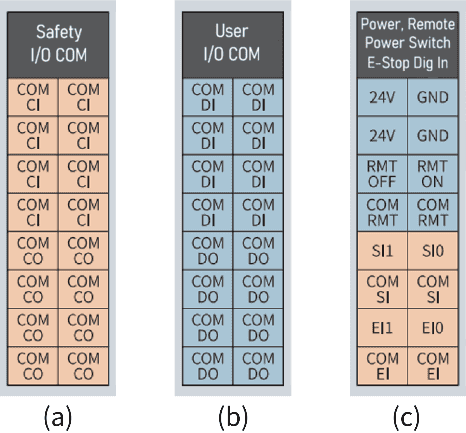
| COM terminal | Function | Quantity | Usage | |
|---|---|---|---|---|
| Input COM | COM SI | Common terminal for external safety stop input | 2 | Used with external safety stop input |
| COM EI | Common terminal for linked emergency stop input | 2 | Used with linked emergency stop input | |
| COM RMT | Common terminal for remote switch input | 2 | Used with remote power-on/off input | |
| COM CI | Common terminal for configurable I/O input | 8 | Used with configurable I/O input | |
| COM DI | Common terminal for general I/O input | 8 | Used with general I/O input | |
| Output COM | COM CO | Common terminal for configurable I/O output | 8 | Used with configurable I/O output |
| COM DO | Common terminal for general I/O output | 8 | Used with general I/O output | |
| Sign | Description |
|---|---|
| 1. The effective I/O level mode is factory-configured. Users shall carefully check the I/O type marks inside the controller. 2. Whether NPN or PNP signal level control is adopted, the active levels of inputs and outputs follow the factory preset configuration. 3. Under both NPN and PNP signal level control modes, the wiring principles of common COM terminals and I/O remain the same. |
9.5 I/O Power Supply
9.5.1 Internal Power Supply
The controller panel I/O uses internal power supply by default, as shown in Figure 9-4. 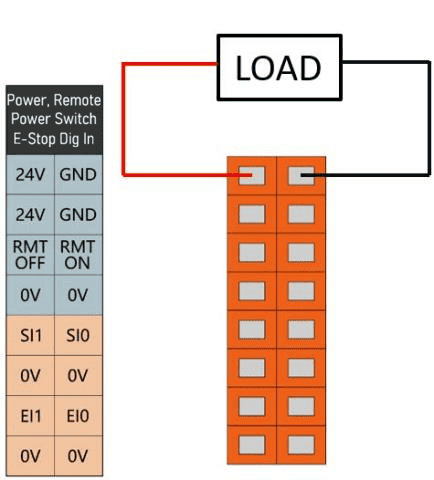
9.5.2 External Power Supply
If an external power supply is required, use the method shown in Figure 9-5. 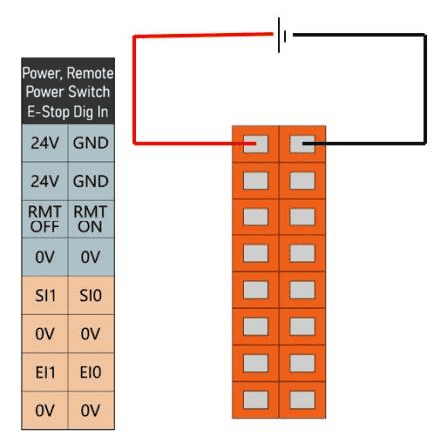
9.6 Fixed-function I/O
9.6.1 Fixed Safety Stop Inputs
The AUBO-CB-iS series controller provides two fixed safety stop inputs:
- External safety stop inputs (SI0, SI1): Used for other safety protection devices.
- Linked emergency stop inputs (EI0, EI1): Used only for emergency stop devices and can implement multi-machine linked emergency stop.
The functional differences between the two are shown in Table 9-3.
| External safety stop input | Linked emergency stop input | |
|---|---|---|
| Robot stops moving | Yes | Yes |
| Program execution | Pause | Stop |
| Robot power | On | Off |
| Reset | Automatic or manual | Manual |
| Usage frequency | No more than once per operating cycle | Infrequent |
| Re-initialization required | No | Brake release only |
| Stop category | Category 2 stop | Category 1 stop |
Note:
For descriptions of stop categories, see Appendix.
| Safety input function | Limit condition | ||
|---|---|---|---|
| Detection time | Power-off time | Reaction time | |
| External safety stop input | 100 ms | 1200 ms | 1300 ms |
| Linked emergency stop input | 100 ms | - | 1200 ms |
9.6.2 Remote Power-on/off
When the system is in manual mode, the remote power-on/off control I/O interface can be used to power the robot system on or off.
| Input | Function definition |
|---|---|
| RTM ON | Remote power-on signal input interface |
| RTM OFF | Remote power-off signal input interface |
9.7 Controller Configurable I/O
The AUBO-CB-iS series controller provides 16 configurable digital input interfaces and 16 configurable digital output interfaces. They adopt a dual-channel safety circuit design, ensuring that the system can maintain safety functions in the event of a single fault.
Configurable I/O can be used as safety I/O only after it is configured in the teaching software. If not configured, it is general digital I/O by default. Safety I/O always has the highest priority. When the same I/O port is configured with both safety I/O and general I/O functions, the system gives priority to retaining the safety I/O function. For details about safety I/O functions and usage, see the AuboStudio User Manual.
When configurable I/O is used as safety I/O, strict safety guidelines must be followed. Before use, all safety devices and related equipment must be installed according to professional safety instructions and undergo a comprehensive risk assessment.
| Input/output | Function definition |
|---|---|
| CI00~CI07 | Set specific functions through the software interface |
| CI10~CI17 | |
| CO00~CO07 | |
| CO10~CO17 |
9.8 Controller General I/O
9.8.1 Function Definition
The AUBO-CB-iS series controller provides flexible general I/O interfaces, including 16 (+16) digital input interfaces, 16 (+16) digital output interfaces, 2 analog voltage input interfaces and 2 analog voltage output interfaces.
The specific functions of general I/O need to be configured in the teaching software. For detailed function descriptions and configuration methods, see the AuboStudio User Manual.
| Input/output | Function definition |
|---|---|
| DI00~DI07 | Set specific functions through the software interface |
| DI10~DI17 | |
| DO00~DO07 | |
| DO10~DO17 | |
| CI00~CI07 | |
| CI10~CI17 | |
| CO00~CO07 | |
| CO10~CO17 | |
| AI0, AI1 | |
| AO0, AO1 |
9.8.2 General Digital I/O Interface
The AUBO-CB-iS series controller provides flexible I/O signal level control schemes.
| Input/output | Parameter | Specification |
|---|---|---|
| DI | Input signal form | NPN/PNP |
| Input mode | Input signal current | |
| Electrical specification | 5 mA/DC24 V | |
| DO | Output signal form | NPN/PNP |
| Electrical specification | 300 mA/DC24 V |
Example
- Digital input interface connected to a push-button switch
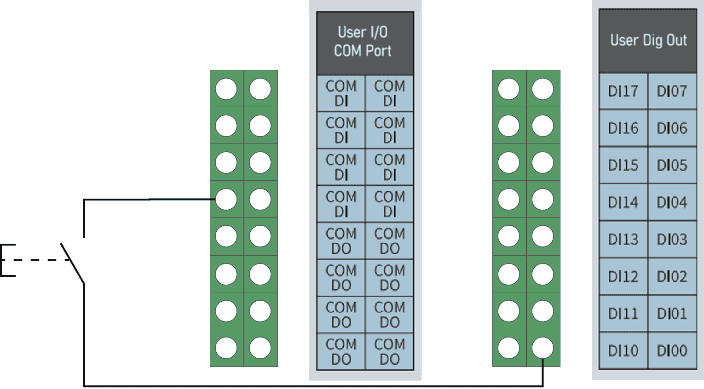
- Digital output interface connected to a load
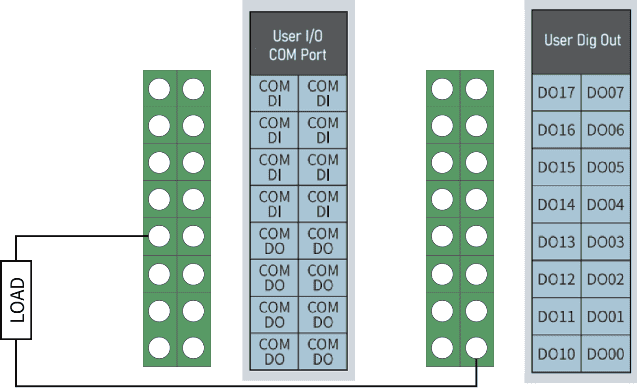
9.8.3 General Analog I/O Interface
The analog I/O interface is located in the leftmost row of terminal interfaces on the controller side panel. It has two analog voltage inputs and two analog voltage outputs, indicated by AI and AO respectively, as shown in Figure 9-8. 
| Type | Voltage |
|---|---|
| Input | 0 ~ +10 V |
| Output | 0 ~ +10 V |
| Accuracy | ±1% |
| Parameter item | Minimum | Maximum | Unit |
|---|---|---|---|
| Input voltage | 0 | +10 | V |
| Input resistance | 100K | Ω | |
| AI sampling resolution | 12 | BITS | |
| AI sampling accuracy | 10 | BITS | |
Example
- Analog voltage input wiring method
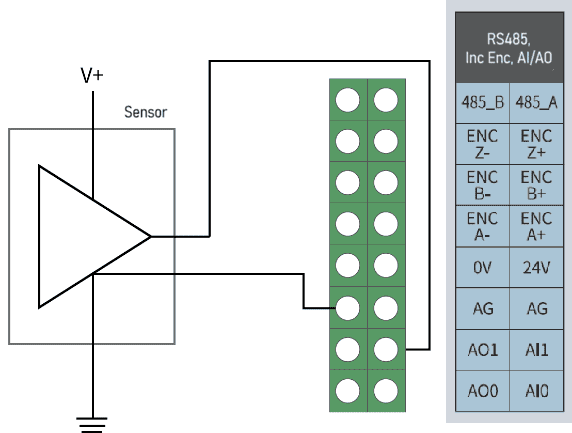
- Analog voltage output wiring method
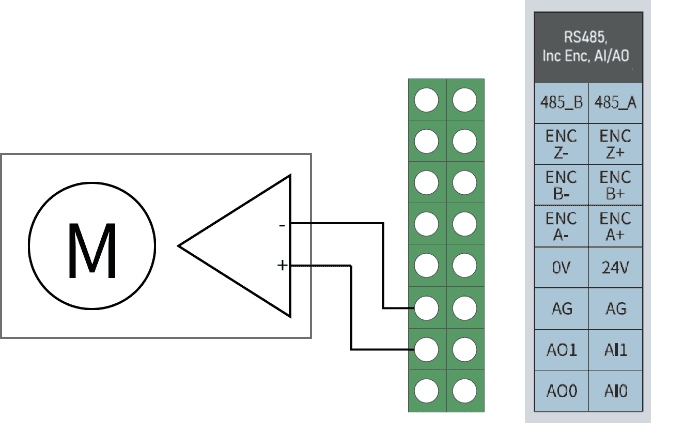
9.9 Terminal Block RS485 Interface
The RS485 interface in the terminal interface is shown in Figure 9-11 and can be used for Modbus RTU communication. 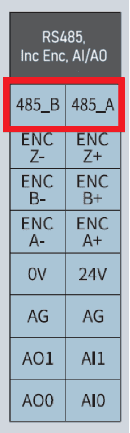
9.10 Incremental Encoder Interface
The incremental encoder interface is shown in Figure 9-12 and can be connected to certain peripherals. 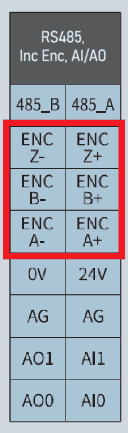
10 Appendix
10.1 Glossary
Category 0 stop: Uncontrolled stop, the power is cut off immediately and the joint brakes are applied without controlled deceleration, so the robot may deviate from the programmed path. It applies only to extreme cases such as exceeding the safety-rated limit or a failure in the safety-rated part of the control system. For the definitions of stop categories and the requirement to remove power immediately, refer to IEC 60204-1:2016 (9.2.2 Stop categories); for the design requirements of the emergency stop function, refer to EN ISO 13850:2015.
Category 1 stop: Controlled stop with power removed afterwards, the robot stops along the programmed path and the power is removed once the stop is achieved, balancing safety and path stability. For the definitions of stop categories and the requirement to remove power after the stop, refer to IEC 60204-1:2016 (9.2.2 Stop categories); for the design requirements of the emergency stop function, refer to EN ISO 13850:2015.
Category 2 stop: Controlled stop with power maintained, the robot remains powered after it stops, and the safety-rated control system holds it in the stopped position so that work can be resumed quickly. For the definitions of stop categories and the requirement to maintain power, refer to IEC 60204-1:2016 (9.2.2 Stop categories). A category 2 stop must not be used as an emergency stop, and is therefore not covered by EN ISO 13850:2015.
10.2 Technical Specifications
10.2.1 AUBO-CB-iS
| Controller type | AUBO-CB-iS | |
|---|---|---|
| Dimensions (L*H*W) | 400 mm * 320 mm * 160 mm | |
| Weight | 12.5 kg (27.5 lbs) | |
| Operating temperature | 0°C ~ 50°C | |
| Operating humidity | 90% relative humidity (non-condensing) | |
| Transport and storage temperature | -25°C ~ 55°C | |
| IP rating | IP43 | |
| Power supply | 100 V ~ 240 V AC, 50 Hz ~ 60 Hz | |
| I/O power supply | 24 V 3 A | |
| I/O ports | Digital input | 16 (general) + 16 (configurable) |
| Digital output | 16 (general) + 16 (configurable) | |
| Analog input | 2 | |
| Analog output | 2 | |
| Incremental encoder | 1 | |
| RS485 | 1 | |
| Wireless module | Optional | |
| Communication protocols | Ethernet, Modbus-RTU/TCP, Profinet, Ethernet/IP (optional) | |
| Interfaces and openness | SDK (C/C++/C#/Lua/Python/JavaScript for Windows + Linux), ROS/ROS2 system support, API | |
| Cables | Robot arm cable | 5 m (customizable, up to 8 m) |
| Teach pendant cable | 4 m | |
| Power cable | 5 m | |
10.2.2 AUBO-CB-iS-H
| Controller type | AUBO-CB-iS-H | |
|---|---|---|
| Dimensions (L*H*W) | 400 mm * 320 mm * 240 mm | |
| Weight | 18 kg (39.7 lbs) | |
| Operating temperature | 0°C ~ 50°C | |
| Operating humidity | 90% relative humidity (non-condensing) | |
| Transport and storage temperature | -25°C ~ 55°C | |
| IP rating | IP43 | |
| Power supply | 100 V ~ 240 V AC, 50 Hz ~ 60 Hz | |
| I/O power supply | 24 V 3 A | |
| I/O ports | Digital input | 16 (general) + 16 (configurable) |
| Digital output | 16 (general) + 16 (configurable) | |
| Analog input | 2 | |
| Analog output | 2 | |
| Incremental encoder | 1 | |
| RS485 | 1 | |
| Wireless module | Optional | |
| Communication protocols | Ethernet, Modbus-RTU/TCP, Profinet, Ethernet/IP (optional) | |
| Interfaces and openness | SDK (C/C++/C#/Lua/Python/JavaScript for Windows + Linux), ROS/ROS2 system support, API | |
| Cables | Robot arm cable | 5 m (customizable, up to 8 m) |
| Teach pendant cable | 4 m | |
| Power cable | 5 m | |
10.3 Revision Records
| Version / Time | Description |
|---|---|
| v1.2.0*/20251010 | v1.2.0* (Trial) released. |
| v1.0.1*/20260827 | 1. Released v1.0.1* trial version. 2. Unified manual structure, safety instructions, chapter names, and warning signs. |
| v1.0.2*/20260922 | 1. Released v1.0.2* trial version. 2. Added descriptions of stop categories in the appendix. |