
AUBO-G Series Robot Arm Product Specs
Product Specs
AUBO-G Series Robot Arm Product Specification v1.0.0
AUBO-G35 Series Robot Arm Product Specification v1.0.0
AUBO-G40 Series Robot Arm Product Specification v1.0.0
Introduction
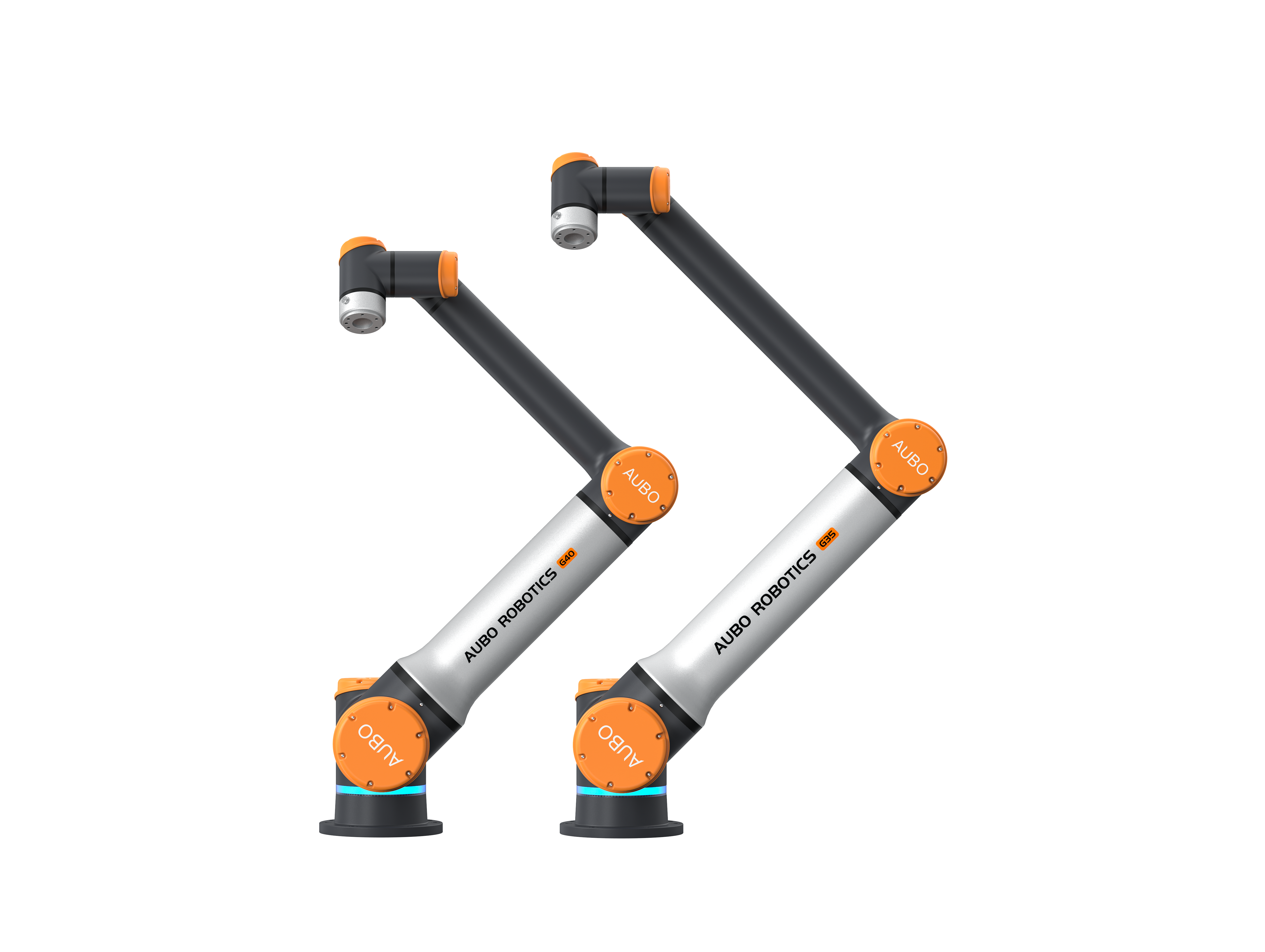
The AUBO-G series is a new-generation flagship collaborative robot launched by AUBO (Beijing) Intelligent Technology Co., Ltd., with core positioning in safety, high performance, and ultra-high payload. The series is equipped with advanced joint sensing and encoding technology, supports EtherCAT communication across the entire line, and adopts a 48 V standard power platform and a 96 V ultra-high payload power platform. It achieves a lightweight design through permanent magnet braking, providing a high-safety, high-performance collaborative solution for ultra-high payload scenarios.
The AUBO-G series robot arms can work with the CB-G40 and CB-G40-MINI controllers.
Applications
The AUBO-G series cobots are widely used in automotive manufacturing, logistics and warehousing, machining, welding, and other industrial scenarios that rely on precise force control, high-speed dynamic response, and heavy payloads.
Features & Advantages
The new G series intelligent adaptive robots have torque sensors built into every joint, come standard with IP67 protection and explosion-proof safety design across the entire line, and are upgraded to a 96 V heavy-payload power platform that greatly improves power efficiency and reduces heat loss. This drives robots to evolve from "rigid execution" to "flexible perception".
Whole-arm force sensing: The all-joint torque sensors achieve an accuracy of 5‰ F.S., precisely capturing subtle changes in contact force and enabling flexible teaching and operation. This ensures process consistency in grinding, assembly, and other tasks, and provides collaborative safety even under heavy payloads.
High-speed precision motion: Equipped with an EtherCAT high-speed bus and AUBO's self-developed vibration suppression algorithm at a 1 kHz control frequency, it achieves microsecond-level synchronization between the controller and the work area, greatly improving start-stop stability under heavy payloads. It delivers micron-level positioning accuracy and repeatability of ±0.05 mm.
Adaptation to harsh environments: The robot arms come standard with IP67 protection and explosion-proof safety design, and support wide-temperature operation from -10 ~ 50°C, handling complex conditions such as cutting fluid spray, smoke and high temperatures, and low-temperature cold-chain environments.
Efficient power architecture: Upgraded to a 96 V heavy-payload power platform, greatly improving power efficiency and reducing heat loss to ensure sustained and stable heavy-payload output; both standard and mini controller options are available to suit different integration needs.
Easy and flexible deployment: The base diameter is only 315 mm, and flexible cable deployment reaches up to 40 m; the G-Pendant teach pendant and the G-STICK tablet handle kit support both wired and wireless operation; wireless teaching supports an operating distance of up to 10 m; AuboStudio software is fully compatible with HarmonyOS and Android.
AUBO-G35 Features
Payload 35 kg, self-weight 115 kg, payload-to-weight ratio 1:3.29; a 2100 mm ultra-long working radius that comfortably covers large pallets and workpieces; maximum joint speed 336°/s and end speed 6.4 m/s. It achieves efficient material flow over a long reach, and is particularly skilled at wide-range palletizing on both sides of a conveyor and loading/unloading of large machined parts.
AUBO-G40 Features
Payload 42 kg, self-weight optimized to 109 kg, payload-to-weight ratio 1:2.6; a 1800 mm working radius, a 43.5% improvement over the same class, with an ultra-lightweight design that facilitates high-position mounting and compact production line layouts; maximum joint speed 336°/s and end speed 5.4 m/s; high-speed start-stop cycle performance is significantly improved over the same class, leading in efficiency for heavy-payload conditions and the intensive transfer of large parts; the combination of heavy payload and lightweight body makes installation and deployment easier and widens the range of applications.