Coordinate System Translation, Rotation, and Position Offset: Basic Principles and Application Examples
Basic Principles
Basic Definitions
Coordinate System: A reference frame defined by an origin and a set of mutually orthogonal, oriented basis axes (usually X, Y, Z), used to uniquely represent the position and orientation of a point in space under specific units.
- 2D contains two axes (X, Y); 3D contains three axes (X, Y, Z);
- It is necessary to agree on chirality (usually the right-hand system) and units (mm, m, etc.);
- Vectors and orientations given relative to the same coordinate system are comparable and composable.
Common Types of Coordinate Transformations
Translation: poseAdd()
- Meaning: Move the position of the same point within the same coordinate system, with its orientation unchanged.
- Formula (with translation when a point expressed in frame B is transformed to frame A):
Here
is responsible for "changing direction", and is responsible for "adding position". For translation only, .
Rotation: poseRotation()
Meaning: Rotate the orientation within the same coordinate system; the position changes in a circular path relative to the origin.
Formula:
, where , satisfying and . Common representations (3D):
- Euler angles ZYX (yaw-pitch-roll):
- Axis-angle (rotation by angle
about the unit axis ): Rodrigues' formula
- Euler angles ZYX (yaw-pitch-roll):
Translation + Rotation Combined (Pose / Homogeneous Transformation): poseTrans()
Pack rotation and translation into a 4×4 matrix:
- Composition order: Right-multiply by the transformation that is closer to the point. For example, first offset/rotate within the TCP's own frame (
), then place it back into the base:
- Inverse transformation poseInverse(): Convert the "pose from B to A" into the "pose from A to B",
Application Examples
1. Point Offset
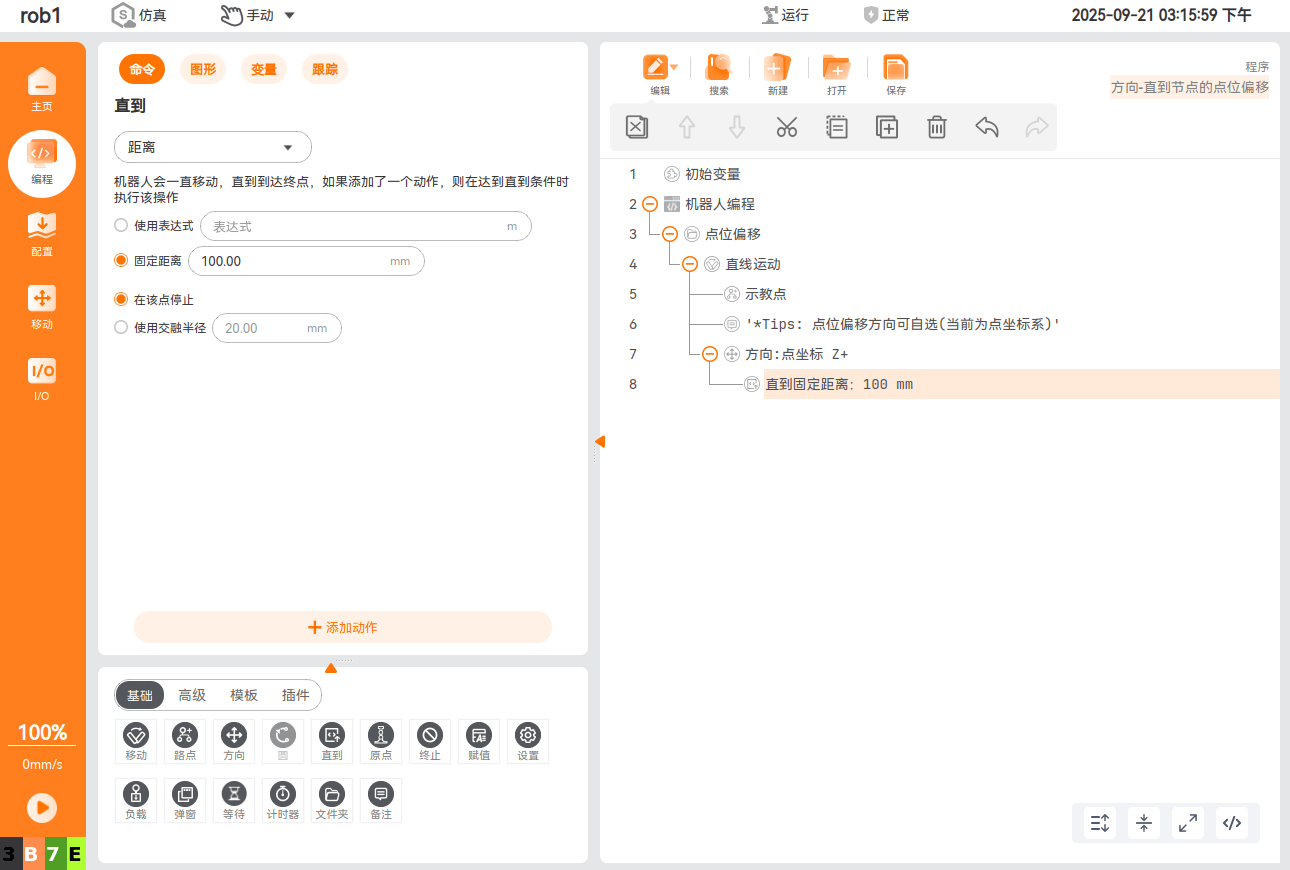
Point offset via the Direction-Until node
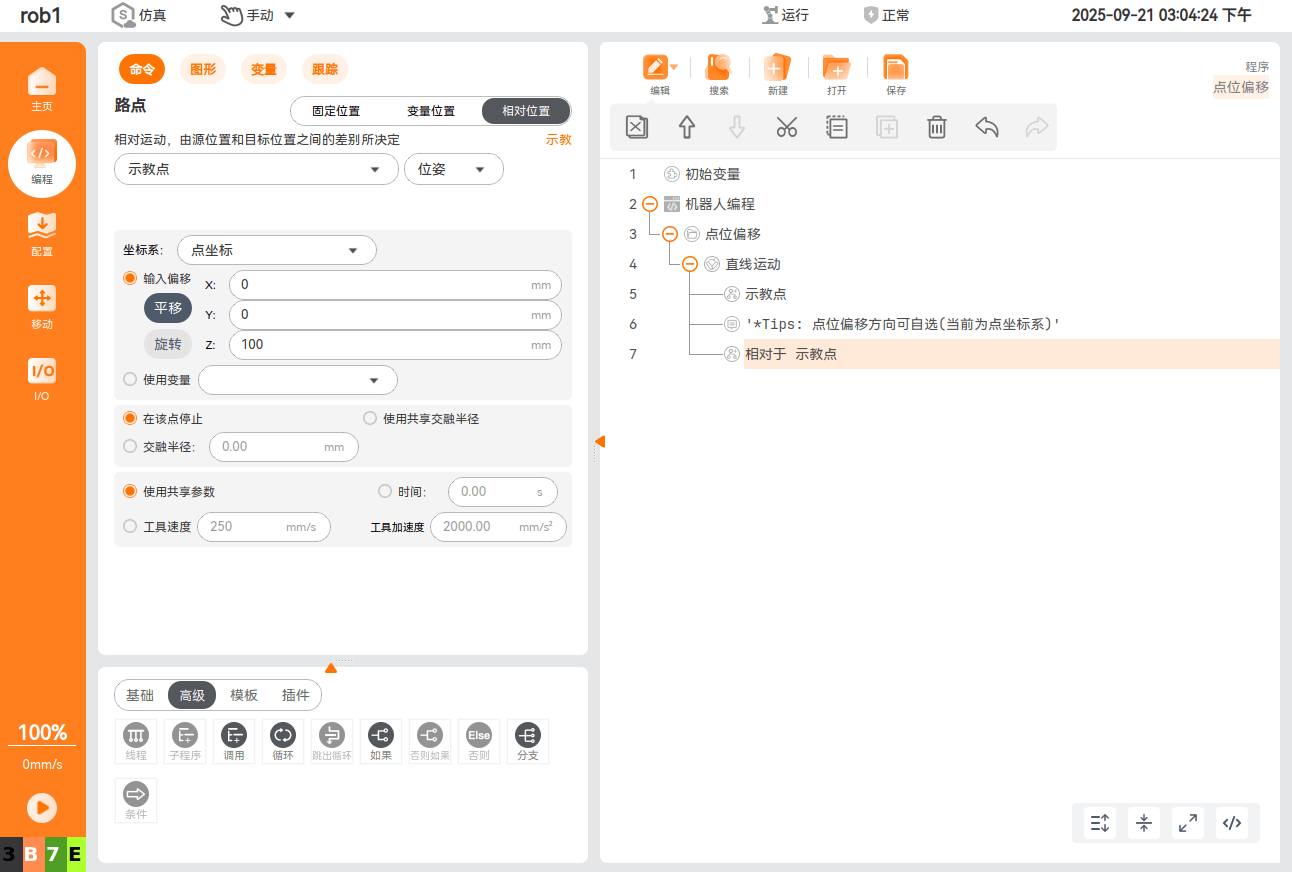
Feature in the 0.31 branch: point offset relative to a variable or waypoint
2. Coordinate System Offset
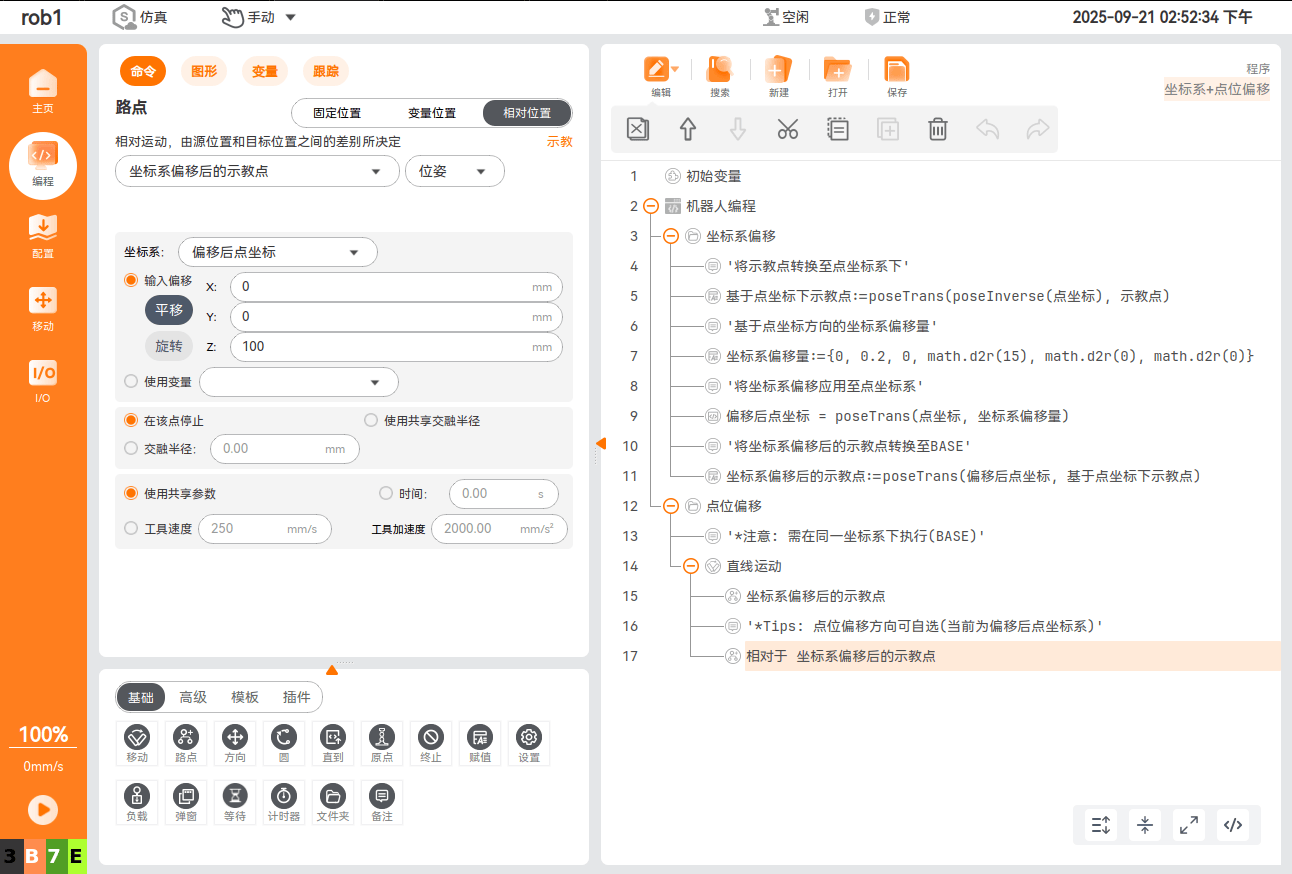
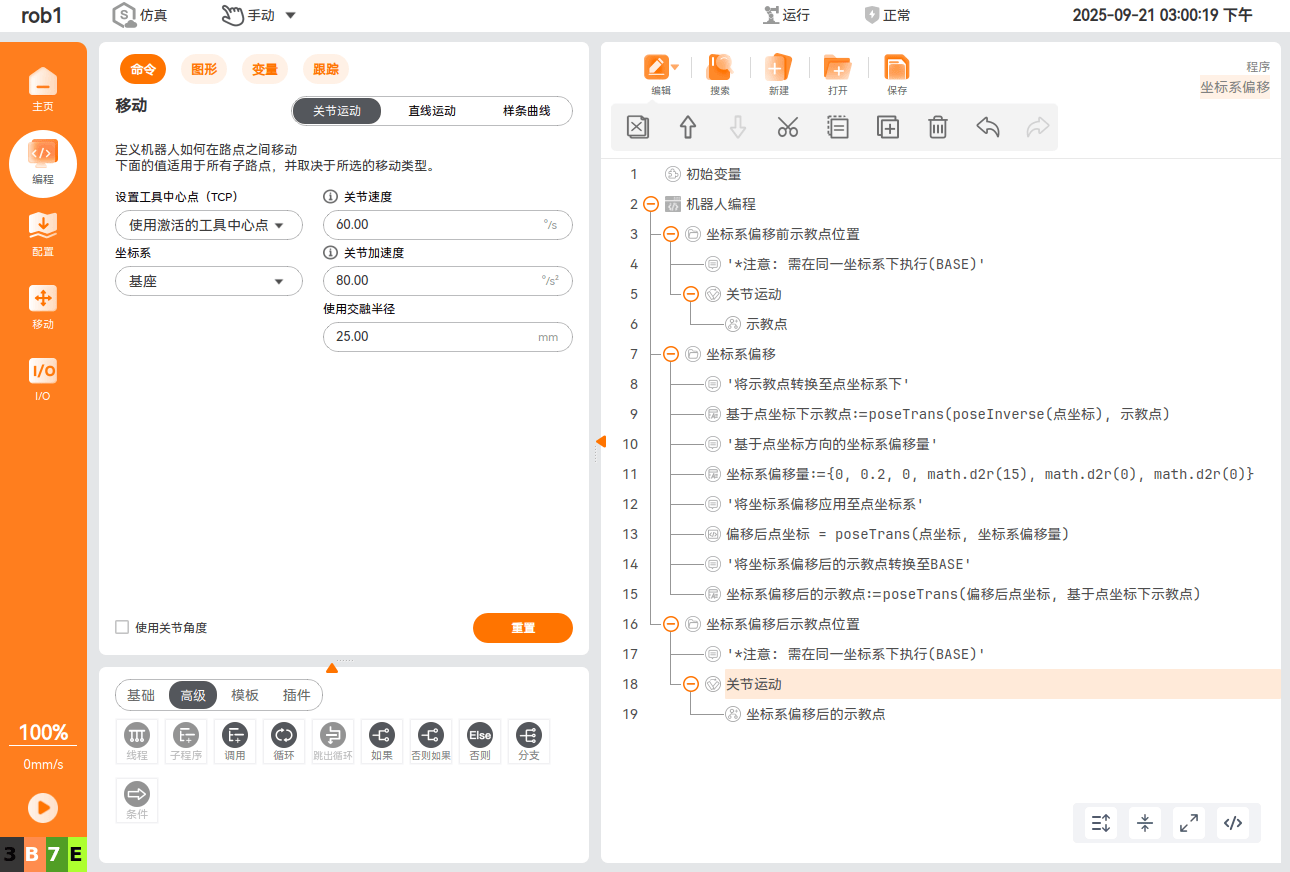
Implement offset via a custom coordinate system
3. Coordinate System + Point Offset